
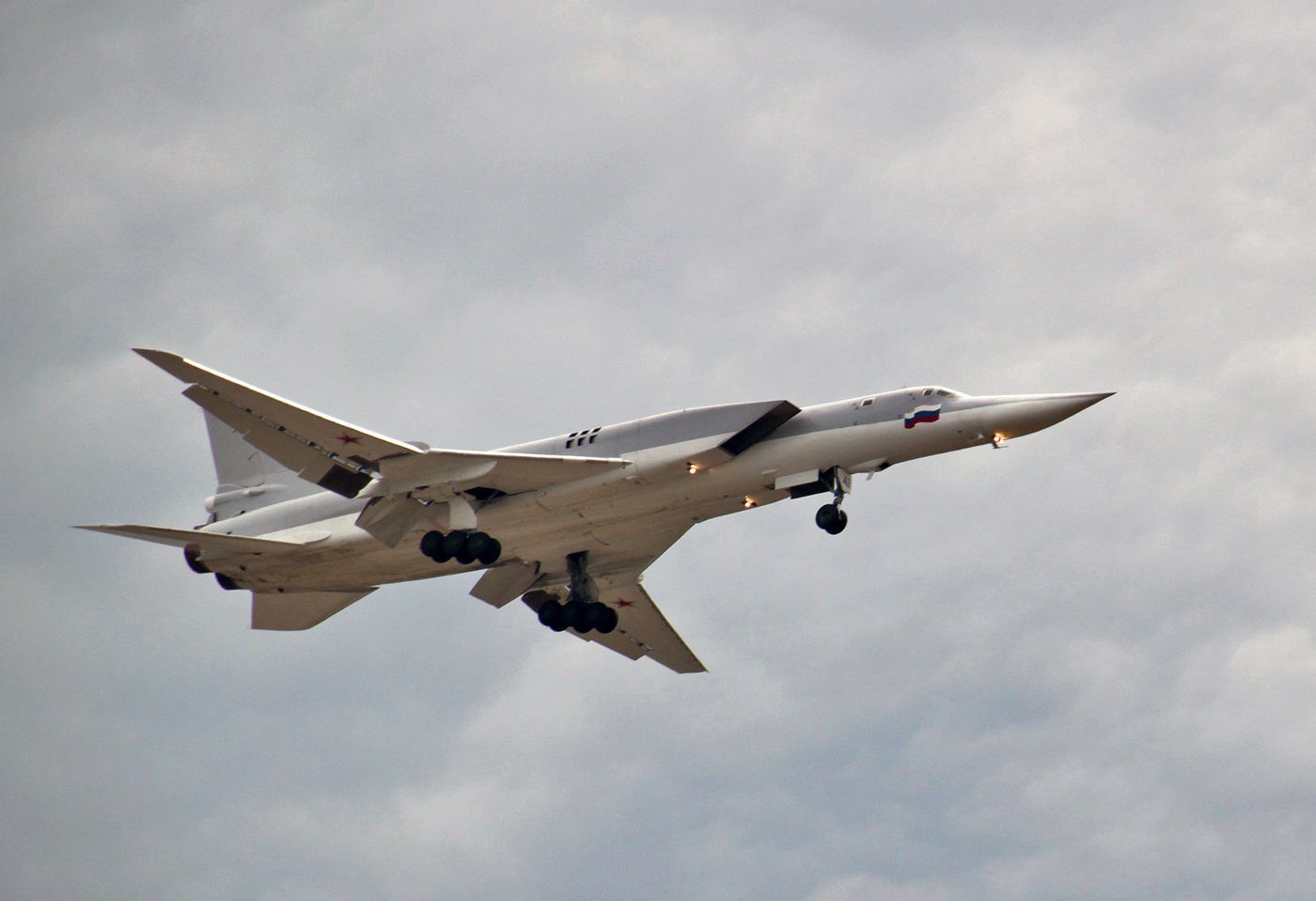
Tu-22M3
Long-range bomberIn serviceFielded 1977Pending verification
Also known as: Backfire
Air ForcesRUS
Fact cardConfidence · Source
System
TypeLong-range bomber
Alternative designationsBackfire
Date of introduction1977
ProliferationAt least 2 countries
Dimensions and weight
Flight performance
Armament and payload
Missile System1-3 x Kh-22MA (NATO AS-4 Kitchen) air-to- surface; or 10 x Kh-15 (NATO AS-6 Kickback) air-to-surface (4 externally and 6 internally on rotary launchers).Med[1]
Bomb System24,000 kg (half internal, half on external racks). The standard load is 69 x FAB-250 or 8 FAB-1500 bombs.Med[1]
Fire control
Target Navigation Radar1 x MTN missile system with integral TV-optical bomb sight, integrated with search radar.Med[1]
Variants
Tu-22Mo Backfire-AThe first bombers received the designation Tu-22Mo. Development began in 1964-65 to meet a joint requirement by the former Soviet air force and navy for a replacement for the Tu-22/Tu-16.[1]
Tu-22M Backfire-AThis was a pre-production series of an estimated 12 aircraft placed in operational service with Soviet naval aviation.[1]
Tu-22M1 Backfire-AThis version first flew on July 1, 1971. Nine were built; a 10th was for static testing.[1]
Tu-22M2 Backfire-BThis was the initial production model, which differed from the Tu-22M3 Backfire-C. It was developed for the long-range strategic bombing role in the early 1970s.[1]
Tu-22M2Ye Backfire-Bhis variant was equipped with the new NK-25 engines and an advanced flight-control system. However, it did not achieve improved flight characteristics.[1]
Tu-22M3 Backfire-CThis version first flew June 20, 1977, and entered serial production that same year. A total of 268 were completed when production ended in 1993.[1]
Tu-22MR Backfire reconnaissance variantThis variant entered made its first flight on Dec. 6, 1985. About a dozen were built between 1989 and 1993.[1]
Tu-22MP escort jammerThis variant, equipped with the Myass jamming system, was developed in the mid-1980s. The program ultimately did not progress due to problems with onboard systems.[1]
Weapons and payload options · 1Confidence · Source
1 × 23-mm GSh-23 cannon in the Remotely Controlled Tail TurretAutocannon
Med[1]- Type
- Autocannon
- Caliber
- 23 mm
- Rate of fire
- 3,400–3,600 rounds/min
Soviet-designed long-range supersonic bomber with variable-sweep wings, first flown in 1977 and used by Russia for standoff missile and bombing strikes.
Draft entry. Values come from the cited public sources and are awaiting editor verification.
- Tu-22M3 (Backfire-C) Russian Long-Range Strategic Bomber, U.S. Army TRADOC G-2 Worldwide Equipment Guide (ODIN)
Published/updated 2026-03-20 · Tier 1 · checked 2026-10-10
- 2026-10-05 Entry created from the Worldwide Equipment Guide (ODIN)
- 2026-10-06 Added photo (CC BY-SA 3.0)