
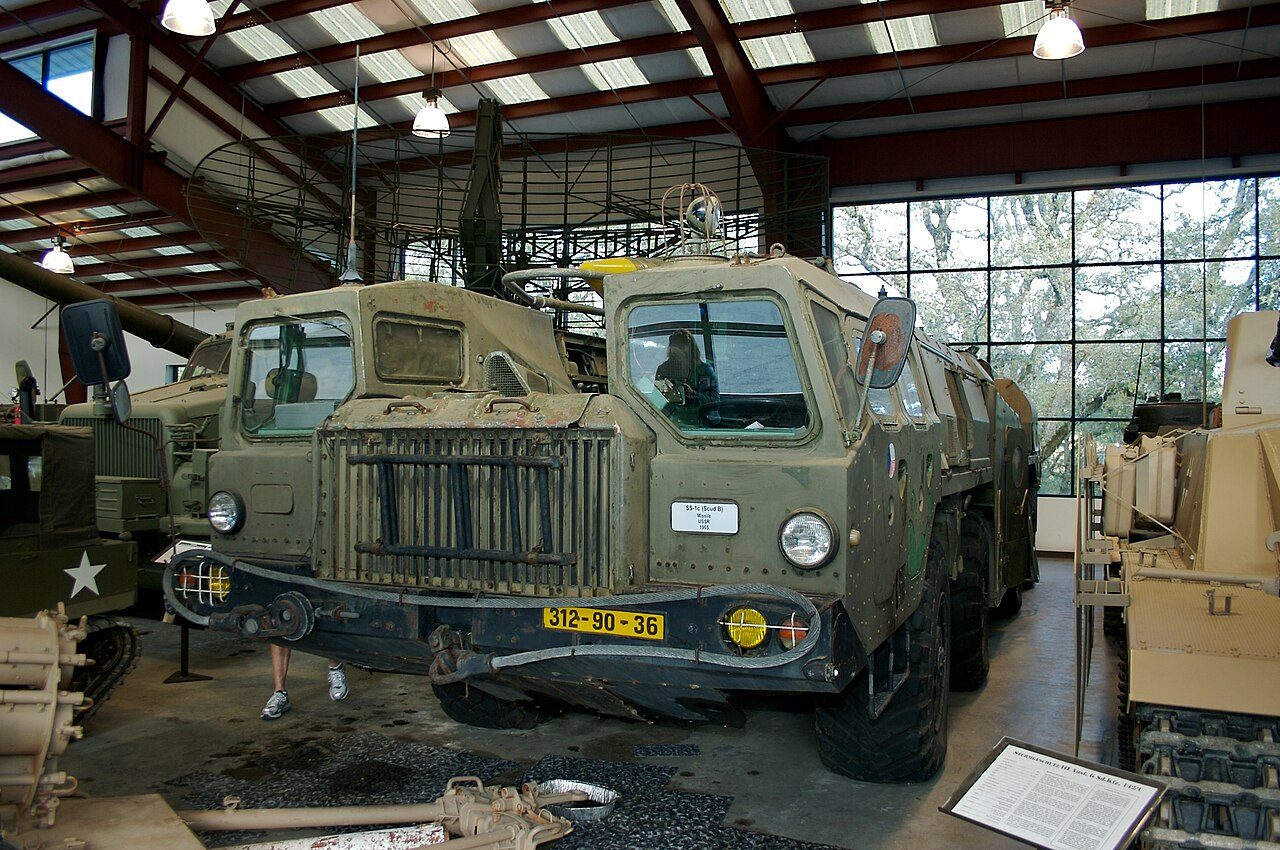
SS-1C (Scud-B)
Close-range ballistic missileFielded 1962Pending verification
Missile ForcesRUS
Fact cardConfidence · Source
System
TypeClose-range ballistic missile
Date of introduction1962
ProliferationAt least 14 countries
Guidancesimplified inertial guidance using three gyroscopes rocket-steered by small vanes on each fin extending into effluxMed[1]
Dimensions and weight
Flight performance
Propulsionsingle-stage storable UDMH liquid propellant with RFNA oxidizer (Russian SG-02 Tonka 250)Med[1]
Payload and range
Warhead5-80 kiloton nuclear; or conventional unitary blast fuel-air explosive; or 40 runway-penetrator submunitions with 410-ft (125-m) blast-damage radius; or 100 11-lb (5-kg) anti-personnel bomblets w/820-Med[1]
Variants
Scud-AThe first of the "Scud" series, designated R-11 (SS-1B Scud-A) originated in a 1951 requirement for a ballistic missile with similar performance to the German V-2 rocket.[1]
Scud-BThe successor to the R-11, the R-17 (SS-1C Scud-B), renamed R-300 in the 1970s, was the most prolific of the series, with a production run estimated at 7,000. It served in 32 countries and four countries besides the Soviet Union manufactured copied versions.[1]
Scud-CThe Makeyev OKB also worked on an extended-range version of the R-17, known in the West as SS-1d Scud-C, that was first launched from Kapustin Yar in 1965. Its range was brought up to 500–600 km but at the cost of a greatly reduced accuracy and warhead size.[1]
Scud-DThe R-17 VTO (SS-1e Scud-D) project was an attempt to enhance the accuracy of the R-17. The Central Scientific Research Institute for Automation and Hydraulics (TsNIAAG) began work on the project in 1968, but the first test launch was conducted only in…[1]
Hwasong-5/Shahab-1North Korea obtained its first Scud-Bs from Egypt in 1979 or 1980. These missiles were reverse-engineered and reproduced using North Korean infrastructure, including the 125 factories at Pyongyang, a research and development institute at Sanum-dong, and the…[1]
Hwasong-6/Shahab-2The Hwasong-6 was first test-flown in June 1990 and entered full-scale production the same year, or in 1991, until it was superseded by the Rodong-1.[1]
Hwasong-7/Shahab-3The Rodong (also NoDong, Hwasong-7, or "Scud-C"), was the first North Korean missile to feature important modifications from the Scud design. Development began in 1988, and the first missile was launched in 1990, but it apparently exploded on its launch pad.[1]
Hwasong-9/Scud-ERThe Hwasong-9 [dubious – discuss] also called the Scud-ER (extended range), is essentially a North Korean modification of the Hwasong-6 that exchanges payload for greater range; estimates range from 700–800 km (430–500 mi) to as much as 995 km (618 mi)…[1]
The successor to the R-11, the R-17 (SS-1C Scud-B), renamed R-300 in the 1970s, was the most prolific of the series, with a production run estimated at 7,000. It served in 32 countries and four countries besides the Soviet Union manufactured copied versions.
Draft entry. Values come from the cited public sources and are awaiting editor verification.
- SS-1C (Scud-B) Russian Close-Range Ballistic Missile, U.S. Army TRADOC G-2 Worldwide Equipment Guide (ODIN)
Published/updated 2026-03-20 · Tier 1 · checked 2026-10-10
- 2026-10-10 Entry created from the Worldwide Equipment Guide (ODIN), bulk import
- 2026-10-10 Added photo (CC BY-SA 3.0)