
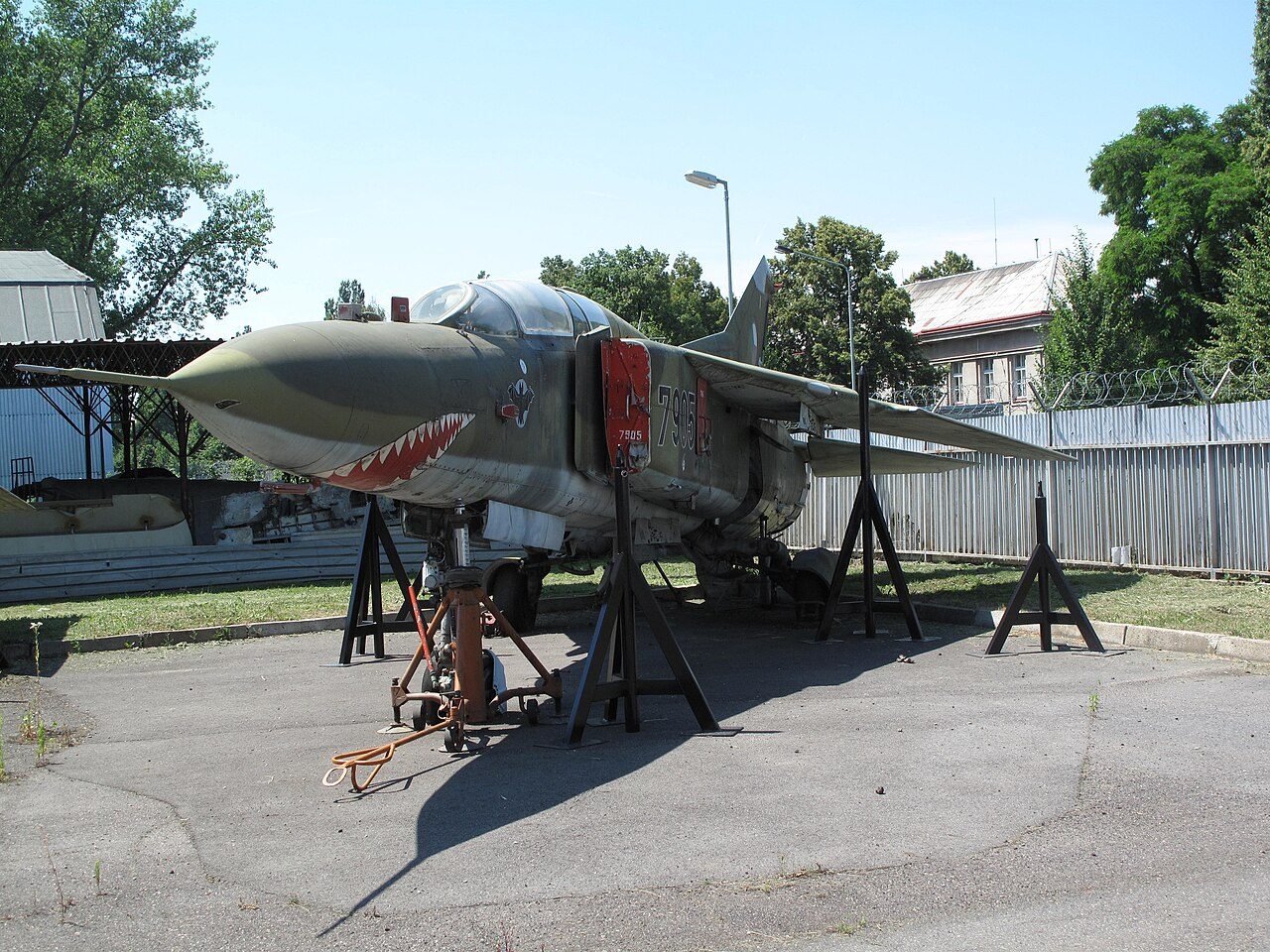
MiG-23 (Flogger)
Fighter aircraftFielded 1970Pending verification
Air ForcesRUS
Fact cardConfidence · Source
System
TypeFighter aircraft
Date of introduction1970
ProliferationAt least 11 countries
Armament and payload
Variants
MiG-23S "Flogger-A"The "Flogger-A" was the initial production variant. An interim variant, it was externally similar to the prototype but as the Sapfir-23 had been delayed it was equipped with the RP-22SM Sapfir radar and lacked an IRST.[1]
MiG-23M "Flogger-B"The "Flogger-B" was the most produced variant of the first-generation 'Floggers,' the MiG-23M first flew in June 1972 and became the VVS' chief air superiority fighter, giving it a true look-down/shoot-down capability.[1]
MiG-23U "Flogger-C"The "Flogger-C" was a twin-seat training variant based on the MiG-23S, first appearing six months after the single-seater's introduction.[1]
MiG-23BM "Flogger-D"The "Flogger-D" is considered an experimental variant and is upgraded with a digital computer and several experimental features, such as it's dielectric heads being moved from the pylons to directly on the wing roots.[1]
MiG-23MS "Flogger-E"The "Flogger-E" was another export variant, and was a downgraded version of the MiG-23M. This variant was designed for to exclude advanced capabilities so as to maintain secrecy.[1]
MIG-23B "Flogger-F"The "Flogger-F" was created to meet the need for a new fighter-bomber, the MiG-23B was similar to the MiG-23S but with a redesigned forward fuselage and a dielectric head just above the pylon.[1]
MiG-23MLA "Flogger G"The "Flogger-G" first flew in 1977, with mass production beginning in 1978 and sales to foreign customers starting in 1981. Externally, the "MLA" had an improved Sapfir-23MLA (N003) radar with better range, reliability and ECM resistance, and a frequency…[1]
MiG-23BK/BN "Flogger-H"The "Flogger-H" BK export was variant reserved for sales exclusively to former Warsaw Pact countries. In addition to the PrNK-23 system, additional radar warning receivers were mounted on the intakes.[1]
Weapons and payload options · 1Confidence · Source
23-mm twin gun, Gsh-23LWeapon
Med[1]- Rate of fire
- 9,000 rpm
The 'swing-wing' MiG-23 (NATO reporting name: Flogger) was developed in the 1960s in response to the US F-14 Tomcat. It succeeded the previous MiG-21.
Draft entry. Values come from the cited public sources and are awaiting editor verification.
- MiG-23 (Flogger) Russian Fighter Aircraft, U.S. Army TRADOC G-2 Worldwide Equipment Guide (ODIN)
Published/updated 2026-03-20 · Tier 1 · checked 2026-10-10
- 2026-10-10 Entry created from the Worldwide Equipment Guide (ODIN), bulk import
- 2026-10-10 Added photo (CC BY 3.0)