
M270 MLRS
Multiple launch rocket systemIn serviceFielded 1983Pending verification
Land ForcesUSA
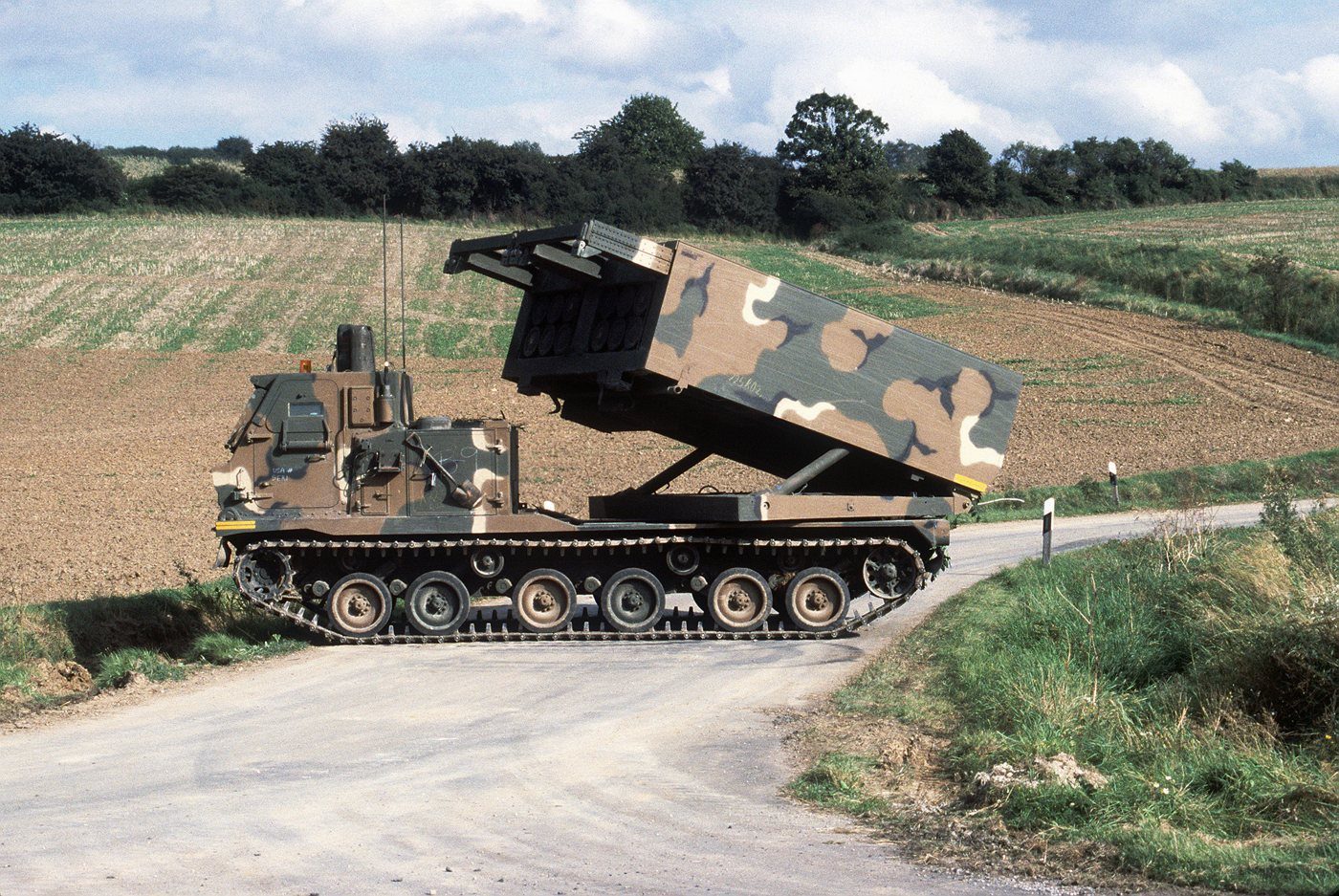
Fact cardConfidence · Source
System
TypeMultiple launch rocket system
Date of introduction1983
ProliferationAt least 13 countries
Dimensions and weight
Automotive performance
TransmissionGeneral Electric HMPT-500 hydro-mechanical; 3 forward/1 reverse range (variable ratios)Med[1]
Suspensiontorsion bar, 6 dual road wheels, front drive, rear idler, 2 shock absorbers, 4 return rollersMed[1]
Protection
Hull ArmorThe cab is protected against small-arms fire and shell fragments by aluminum armor and louvred windows. Some U.S. M270s are equipped with a Mk 19 40-mm automatic grenade launcher on the roof.Med[1]
Armament
Fire control
Variants
M270is the original version, which carries a weapon load of 12 rockets in two six-pack launch pod containers. This armored, tracked mobile launcher uses a stretched Bradley chassis and has a high cross-country capability.[1]
M270 IPDSwas an interim upgrade applied to a select number of launchers to provide the ability to fire the longer-range GPS-aided ATACMS Block IA, quick-reaction unitary and Block II missiles until sufficient M270A1 launchers wer[1]
M270A1was the result of a 2005 upgrade program for the U.S. Army, and later on for several other states. The launcher appears identical to M270, but incorporates an improved fire control system (IFCS) and an improved launcher [1]
M270B1is a British Army upgrade, similar to the A1, but it also includes an enhanced armor package, which gives the crew better protection against IED attacks.[1]
M270C1was an upgrade proposal from Lockheed Martin involving HIMARS Universal Fire Control System (UFCS) instead of IFCS[1]
MARS2 / LRUis a European upgrade of M270 involving Germany, Italy and France. MARS2 is equipped with a new fire control system (EFCS - European Fire Control System) designed par Airbus Defense and Space. EFCS enables firing of M31,[1]
Weapons and payload options · 3Confidence · Source
M26 (Phase I)ammunition
Med[1]- Range
- 32 km20 mi · 17 nmi
- Quantity
- INA
- Warhead
- 156 kg
AT2 (Phase II)ammunition
Med[1]- Range
- 40 km25 mi · 22 nmi
- Quantity
- INA
- Warhead
- 107 kg
GMLRSammunition
Med[1]- Range
- 60 km37 mi · 32 nmi
- Quantity
- INA
The M270 Multiple Launch Rocket System (M270 MLRS) is an armored, self-propelled, multiple rocket launcher (a type of rocket artillery). Since the first M270s were delivered to the U.S.
Draft entry. Values come from the cited public sources and are awaiting editor verification.
- M270 American Multiple Launch Rocket System (MLRS), U.S. Army TRADOC G-2 Worldwide Equipment Guide (ODIN)
Published/updated 2026-03-20 · Tier 1 · checked 2026-10-10
- 2026-10-04 Entry created from the Worldwide Equipment Guide (ODIN)
- 2026-10-05 Added photo (Public domain)