
BMD-3
Airborne amphibious infantry fighting vehicleFielded 1990Pending verification
Land ForcesRUS
Fact cardConfidence · Source
System
TypeAirborne amphibious infantry fighting vehicle
Date of introduction1990
ProliferationAt least 4 countries
Dimensions and weight
Automotive performance
Protection
Hull ArmorThe protection offered is thought to be sufficient to stop up to 12.7 mm rounds fired at the front of the hull and at least 7.62 mm rounds fired at the sides.Med[1]
Smoke EquipmentYes, three 81 mm electrically-operated smoke grenade dischargers. The BMD-3 ACV can lay its own smoke screen by injecting diesel fuel into the exhaust.Med[1]
Armament
Main armament1 x AGS-17 Plamya, 30mm Automatic Grenade Launcher, 1 × turret-mounted 30 mm 2A42 Autocannon, 30 mmMed[1]
Secondary armament1 x PKT 7.62mm (Kalashnikov's Machine Gun) General-Purpose Machine Gun; The 7.62 PKT can be controlled remotely and is slaved to the main gun,Med[1]
Fire control
Variants
BMD-3KThe commander variant of the BMD-3 adopted by the Russian Army in 1996. Mass production of this vehicle was never initiated.[1]
2S25 Sprut-SD (Object 952)A self-propelled anti-tank gun that entered service in 2005. This vehicle has the chassis of the BMD-3 and is operated by a crew of three. The main armament is the 125 mm 2A75 smoothbore gun which is a variant of the 2A4[1]
BTR-MD “Rakushka” (Object 955)A multi-role transport vehicle with bigger hull and no turret. This type can be used to transport troops, fuel, ammunition and wounded personnel. It also serves as the basis for a new range of specialised vehicles for th[1]
RKhM-5 (Object 958)A chemical reconnaissance vehicle introduced in 2011 and is fitted with the same specialized equipment as the BTR-80 version known as the RKhM-4. The turret has been removed; the RKhM-5 has a fixed superstructure with a [1]
BMD-4 (Object 960)Originally designated as the BMD-3M, this vehicle has a modified chassis with new turret known as the "Bakhcha-U". The weaponry bears greater similarity to the BMP-3. This new armament consists of: a 100 mm 2A70 rifled m[1]
Weapons and payload options · 5Confidence · Source
HEI30 mm ammunition
Med[1]- Quantity
- 860 Rounds
- Muzzle velocity
- 960 m/s
- Projectile weight
- 389 g
APFSDS-T30 mm ammunition
Med[1]- Quantity
- 860 Rounds
- Muzzle velocity
- 1,260 m/s
- Projectile weight
- 235 g
APDS30 mm ammunition
Med[1]- Quantity
- 860 Rounds
- Muzzle velocity
- 1,120 m/s
- Projectile weight
- 304 g
30mm Grenadeammunition
Med[1]- Quantity
- 40 ea
- Muzzle velocity
- 185 m/s
- Warhead
- High explosive fragmentation warhead.
30mm Grenadeammunition
Med[1]- Quantity
- 40 ea
- Muzzle velocity
- 185 m/s
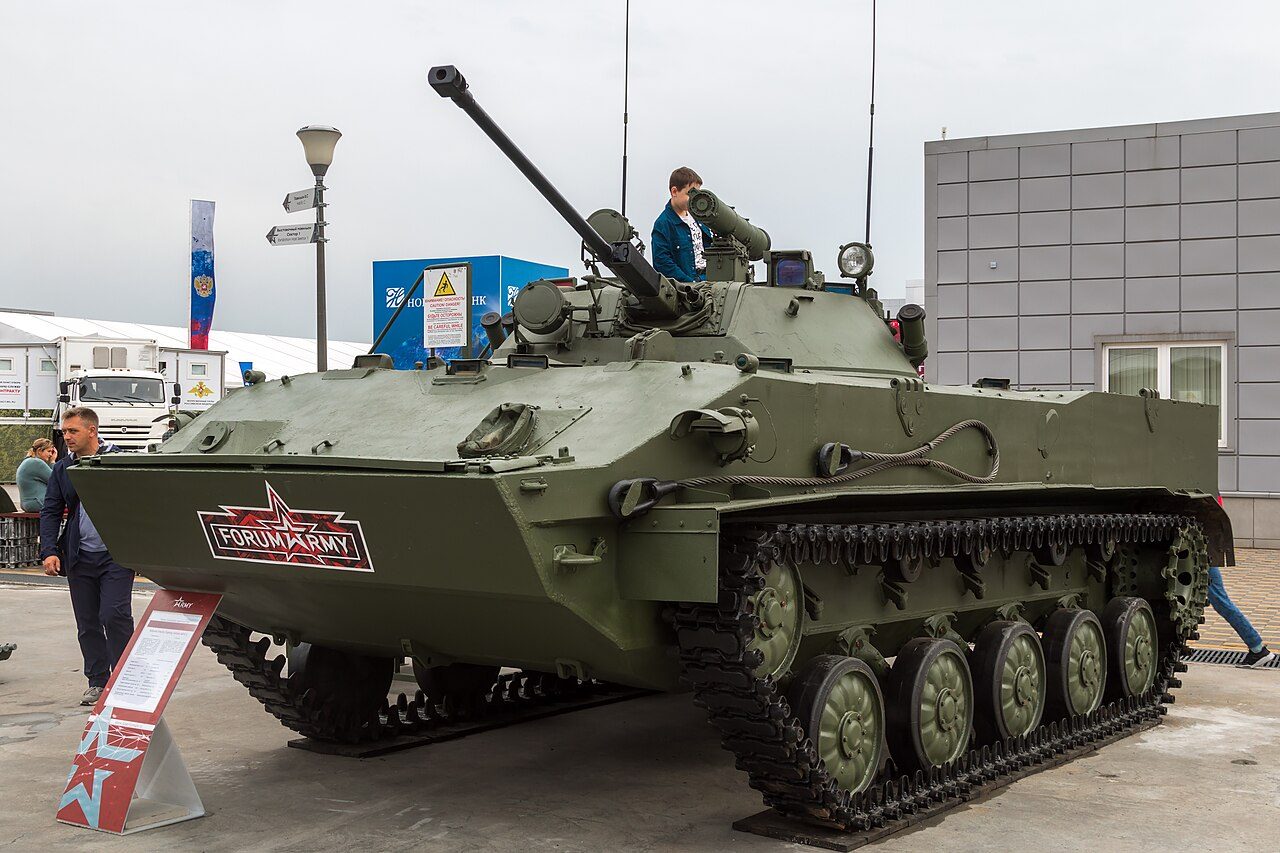
The BMD-3 (Boyevaya Mashina Desanta, Russian "Боевая Машина Десанта", literally "Combat Vehicle of the Airborne") is an infantry fighting vehicle (IFV) originating from the former Soviet Union. The BMD-3 was designed to address the flaws in the BMD-1 and BMD-2 designs.
Draft entry. Values come from the cited public sources and are awaiting editor verification.
- BMD-3 Russian Airborne Amphibious Infantry Fighting Vehicle (IFV), U.S. Army TRADOC G-2 Worldwide Equipment Guide (ODIN)
Published/updated 2026-03-20 · Tier 1 · checked 2026-10-10
- 2026-10-10 Entry created from the Worldwide Equipment Guide (ODIN), bulk import
- 2026-10-10 Added photo (CC BY-SA 4.0)